

Prime Minister Shri Narendra Modi’s recent remarks in the Netherlands may prove to be one of the most important economic warnings issued by an Indian leader in recent years. At a time when much of the world remains distracted by immediate political conflicts and headline-driven geopolitics, the Prime Minister chose to speak about something deeper, the possibility of a global economic regression capable of reversing decades of poverty reduction and developmental progress.
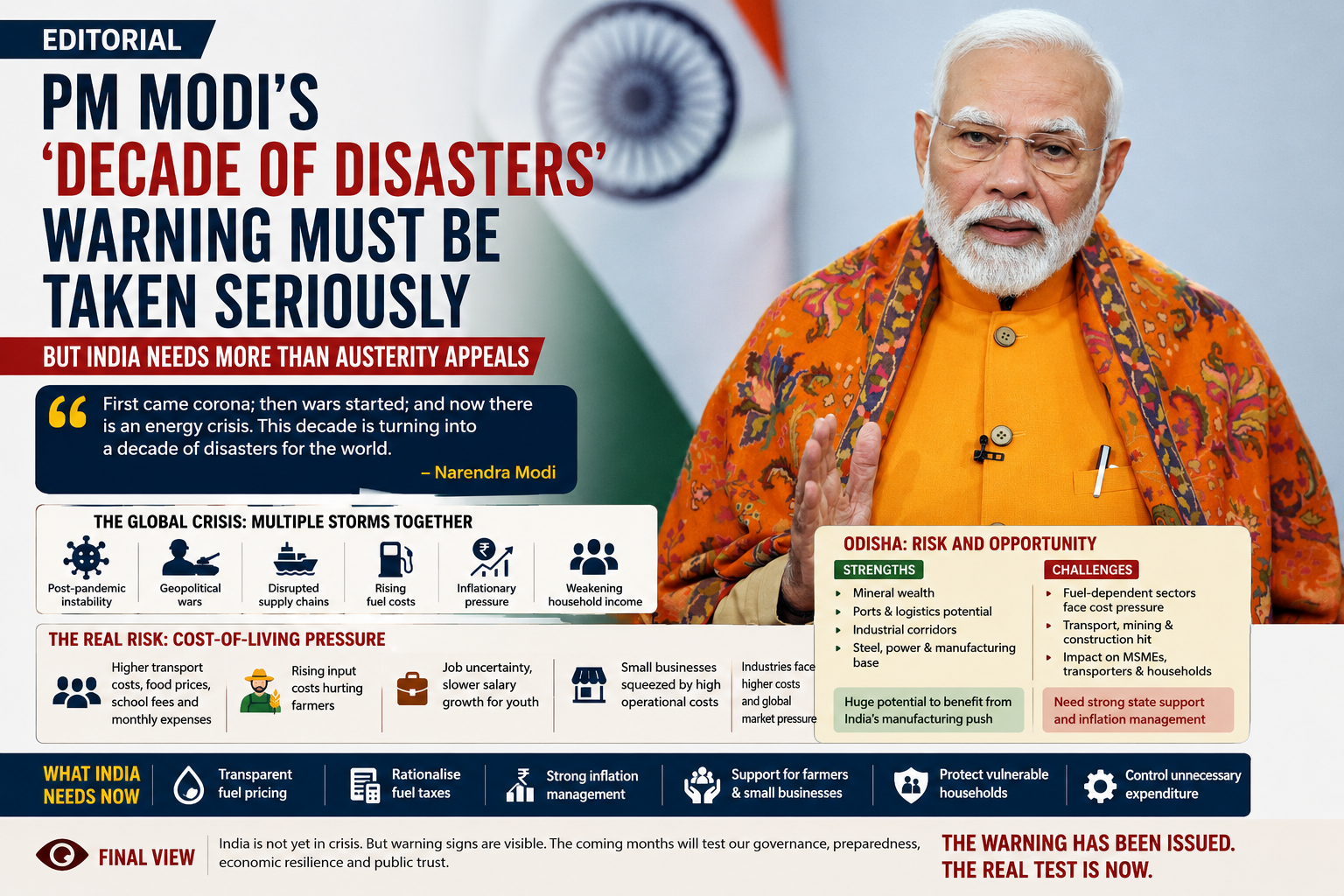
“First came corona; then wars started; and now there is an energy crisis. This decade is turning into a decade of disasters for the world,” PM Modi stated.
From an economic standpoint, this warning is neither exaggerated nor politically dramatic. In fact, it reflects a growing global concern that the world economy is entering a dangerous phase where multiple crises are colliding simultaneously:
- lingering post-pandemic instability,
- geopolitical wars,
- disrupted supply chains,
- rising fuel costs,
- inflationary pressure,
- and weakening household purchasing power.
The danger today is not a single crisis. The danger is the cumulative impact of several crises feeding into one another.
India’s Biggest Vulnerability: Energy Dependence
India’s greatest economic vulnerability in the present situation remains its dependence on imported crude oil.
With nearly 90% of its crude oil requirements imported and a substantial portion passing through the strategically sensitive Strait of Hormuz, India remains highly exposed to geopolitical tensions in West Asia.
The recent disruption in the region has already triggered fuel price hikes after years of relative stability. While the immediate increase of ₹3 per litre may appear moderate on paper, economists understand that fuel inflation never remains limited to petrol pumps.
It quietly enters:
- transportation costs,
- food supply chains,
- agriculture,
- freight rates,
- factory production,
- electricity costs,
- and ultimately household expenses.
This is how energy shocks slowly transform into inflation shocks.
The Real Risk: Cost-of-Living Pressure on Ordinary Citizens
The most immediate danger for India is not recession. It is prolonged cost-of-living stress.
The poor and lower-middle class will feel the impact first:
- rising transportation expenses,
- higher prices of vegetables and essentials,
- increasing farming costs,
- school transport hikes,
- and shrinking disposable income.
India may not be on the verge of an economic collapse, but it is certainly entering a high-risk inflationary environment where economic pressure on ordinary households could intensify over the coming months if global instability continues.
For middle-class families, the pressure may initially appear gradual, but over time it affects almost every aspect of daily life:
- household savings,
- monthly budgets,
- travel,
- education expenses,
- housing costs,
- and lifestyle spending.
Young professionals and salaried employees may also begin facing:
- slower salary growth,
- cautious hiring by companies,
- delayed promotions,
- and increased competition in the job market.
The concern is not panic or immediate collapse. The concern is long-term financial pressure slowly reducing the economic comfort of ordinary citizens.
Impact on Farmers and Small Businesses
Fuel inflation affects farmers heavily because diesel powers:
- tractors,
- irrigation systems,
- rural transportation,
- and agricultural supply chains.
When fuel becomes expensive:
- fertiliser costs rise,
- transportation of crops becomes costlier,
- and profit margins reduce for farmers.
Small businesses and MSMEs are equally vulnerable.
Local traders, transporters, small manufacturers, restaurants, service providers, and shop owners usually operate on limited margins. Unlike large corporations, they often lack the financial capacity to absorb long-term increases in transportation and operational costs.
If inflation continues rising:
- customer spending slows,
- business margins shrink,
- and local economic activity weakens gradually.
This is where government support becomes critically important.
What Happens to Large Industry Houses?
Large industrial groups such as:
- Reliance,
- Adani Group,
- Tata Group,
- JSW,
- Welspun Group,
- and major infrastructure and logistics companies
are financially stronger and better equipped to manage global volatility. However, even they are not immune from prolonged economic disruptions.
They may face:
- rising logistics expenses,
- higher raw material costs,
- export uncertainty,
- slower global demand,
- and cautious expansion planning.
Sectors heavily dependent on:
- fuel,
- shipping,
- steel,
- chemicals,
- cement,
- infrastructure,
- and global trade
could experience increasing operational pressure.
At the same time, crises often create opportunities for large industrial groups. Governments generally respond to economic slowdowns through:
- infrastructure spending,
- manufacturing incentives,
- logistics expansion,
- and domestic industrial development.
This could benefit companies involved in:
- manufacturing,
- energy,
- logistics,
- ports,
- industrial infrastructure,
- and “Make in India” initiatives.
Odisha’s Position: Risk and Opportunity Together
For Odisha, the situation presents both challenges and opportunities.
The state possesses major economic strengths:
- mineral resources,
- operational ports,
- industrial corridors,
- steel and metal industries,
- logistics potential,
- power generation capacity,
- and large-scale industrial land availability.
Because of these advantages, Odisha could emerge as one of India’s key beneficiaries if the country accelerates:
- domestic manufacturing,
- export infrastructure,
- logistics expansion,
- and eastern India industrial development.
This is precisely why the Odisha Government under Chief Minister Mohan Charan Majhi is aggressively focusing on:
- industrial investment,
- infrastructure development,
- ports,
- manufacturing ecosystems,
- and investor outreach programmes.
However, Odisha is also deeply connected to sectors highly sensitive to fuel costs:
- mining,
- transportation,
- steel,
- logistics,
- construction,
- and industrial supply chains.
If global fuel prices continue rising sharply:
- transportation costs will increase,
- industrial operations may become more expensive,
- and smaller contractors, suppliers, transporters, and MSMEs across Odisha could face pressure.
Urban households in:
- Bhubaneswar,
- Cuttack,
- Rourkela,
- Sambalpur,
- and Berhampur
may gradually experience higher monthly living expenses.
Rural Odisha may feel pressure through:
- farming costs,
- diesel prices,
- and transportation-linked inflation.
PM Modi Is Correct, But Warnings Alone Are Not Enough
To be fair, the Prime Minister is correct in identifying the seriousness of the global situation.
The world today is indeed facing:
- energy insecurity,
- fragile supply chains,
- war-driven commodity volatility,
- and slowing economic confidence.
However, public confidence will ultimately depend not on speeches, but on policy execution.
The government’s appeal for voluntary austerity, work from home, reduced fuel usage, limited overseas travel, and lower non-essential consumption, may be economically sensible in the short term. But austerity messaging works only when citizens feel the burden is being shared fairly across all sections of society.
People will now expect:
- transparent fuel pricing mechanisms,
- rationalisation of fuel taxes where possible,
- stronger inflation management,
- protection for vulnerable households,
- support for farmers and small businesses,
- and tighter control on avoidable expenditure.
Political Timing Will Also Be Questioned
The opposition’s criticism regarding the timing of fuel price hikes cannot be ignored entirely.
Many citizens will naturally ask:
Why were prices stable during election cycles but revised afterward?
In a democracy, economic credibility depends not only on fiscal decisions, but also on public trust and consistency.
The BJP argues that state-run oil companies absorbed global price shocks for weeks before passing on a limited burden to consumers. That argument carries some economic validity. But politically, perception matters as much as policy.
The World Is Entering an Uncertain Economic Decade
Across Asia and Europe, governments are already preparing for prolonged instability:
- energy emergencies,
- reserve oil releases,
- electricity conservation campaigns,
- and inflation management interventions.
This is no longer a temporary disruption. The world is entering a structurally uncertain phase where:
- wars impact oil,
- oil impacts inflation,
- inflation impacts growth,
- and slowing growth impacts employment and poverty.
That is the real danger PM Modi was pointing toward.
Final Editorial View
India is not yet in crisis. Odisha is not collapsing. But the warning signs are visible.
PM Modi’s remarks should not be dismissed as political rhetoric or diplomatic commentary. Economically, they reflect a realistic assessment of a fragile global order under pressure from war, energy insecurity, and inflation.
The challenge before India now is not merely economic management. It is social stability management.
If inflation rises sharply while incomes remain stressed, the burden will fall disproportionately on ordinary citizens. That is where governments must act decisively, transparently, and compassionately.
The coming months may define whether this becomes merely a difficult economic phase, or the beginning of a prolonged global cost-of-living crisis capable of pushing millions back towards financial vulnerability.
India still possesses strong economic fundamentals:
- a large domestic market,
- expanding infrastructure,
- growing manufacturing capacity,
- and rising industrial states like Odisha.
But resilience alone will not be enough. The coming years will require:
- disciplined governance,
- inflation control,
- strategic energy planning,
- industrial stability,
- and honest communication with citizens.
The warning has already been issued.
The real test now lies in governance, preparedness, economic resilience, and public trust.