

CM Mohan Charan Majhi pushes for secure state-governed infrastructure, voice-enabled public services and population-scale artificial intelligence solutions
Odisha has taken a decisive step towards becoming one of India’s leading artificial intelligence destinations, unveiling an ambitious vision to build a secure, sovereign, inclusive and Odia-first AI ecosystem capable of transforming governance and public-service delivery across the state.
Moving beyond the conventional approach of using artificial intelligence only for isolated technology projects, the Government of Odisha is preparing to develop AI as a long-term public capability. The proposed ecosystem is intended to combine secure computing infrastructure, state-governed data platforms, local-language technology, skilled human resources and practical applications capable of serving citizens at scale.
The initiative is closely aligned with Odisha’s long-term development roadmaps under Vision 2036 and Vision 2047. It seeks to ensure that the benefits of emerging technology are not restricted to large cities, technology professionals or English-speaking users, but reach farmers, students, patients, frontline workers, tribal communities and residents of remote areas.
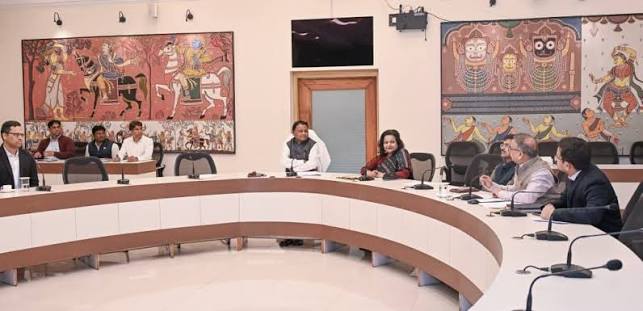
A high-level strategic meeting was held with the leadership of Indian artificial intelligence company Sarvam AI to discuss the development of sovereign infrastructure and population-scale applications in education, agriculture, healthcare, e-governance and other public-service sectors.
The meeting was attended by Chief Minister Mohan Charan Majhi, Electronics and Information Technology Minister Dr Mukesh Mahaling, Chief Secretary Anu Garg, senior government officials and representatives of Sarvam AI.
CM Majhi Calls for Odisha to Lead, Not Merely Follow
Chief Minister Mohan Charan Majhi made it clear that Odisha’s ambition must extend far beyond the routine adoption of new technology. The state, he emphasised, should become a leader capable of establishing new national benchmarks in AI-enabled governance and citizen service delivery.
The Chief Minister’s vision places public interest at the heart of technological transformation. Under this approach, artificial intelligence would not be treated merely as a commercial tool or administrative convenience. It would be developed as a public resource that helps government institutions respond faster, communicate more effectively and deliver services more efficiently.
Odisha’s approach is particularly significant because it seeks to combine technological ambition with linguistic inclusion, data security and institutional accountability.
Rather than depending entirely on external platforms, the government is examining how critical AI infrastructure, public datasets, models and intelligence systems can remain within a trusted framework governed by the state.
This represents a major policy shift-from consuming AI services to building long-term public capacity around artificial intelligence.
Odia-First AI to Take Technology to Every Citizen
One of the most important pillars of the initiative is the development of AI systems that can understand and communicate in Odia.
Language remains a major barrier preventing many citizens from fully accessing digital services. A large number of existing platforms depend on English-language text, complicated menus or smartphone applications that may be difficult for elderly residents, people with limited digital literacy and citizens living in remote or tribal areas.
Odisha’s proposed AI ecosystem aims to address this challenge through voice-enabled conversational services.
A citizen could potentially speak naturally in Odia to seek information about a government scheme, register a grievance, obtain an agricultural advisory, understand a medical referral or learn the status of an application. The system could interpret the request and provide a simple spoken response without requiring the user to navigate complex digital forms.
This voice-first model could make government services more accessible to people who may not be comfortable typing or reading lengthy instructions.
An Odia-first AI system could also improve the quality of communication between citizens and public institutions by reducing dependence on intermediaries and making official information available in an understandable form.
AI for Education: Personalised Support in the Mother Tongue
Education has been identified as one of the priority sectors for population-scale AI applications.
Odia-language learning assistants could help students understand difficult concepts, practise lessons and receive explanations tailored to their level of learning. Such tools could be especially valuable in rural schools where access to specialised teaching support may be limited.
Teachers could use AI to prepare learning materials, assess common areas of difficulty and provide additional assistance to students who require it. The technology could also support translation, pronunciation, digital content creation and vocational training.
However, the proposed model is not intended to replace teachers. Its larger purpose would be to strengthen their capacity and reduce repetitive administrative work so that they can devote more time to classroom engagement and student development.
For Odisha’s youth, the development of AI infrastructure could also create new opportunities in data engineering, language technology, software development, cybersecurity, cloud operations, research and responsible AI deployment.
Agriculture: Local and Timely Advice for Farmers
Artificial intelligence could have an equally important role in agriculture, where timely and location-specific information often determines the difference between a successful crop and a major loss.
Voice-enabled agricultural systems could provide farmers with information on crop conditions, weather patterns, pest risks, irrigation requirements, soil health and government support schemes.
By combining verified agricultural information with relevant local data, such platforms could deliver recommendations in Odia through ordinary mobile phones or voice interfaces.
Farmers would not necessarily need sophisticated devices or advanced technical knowledge. A conversational platform could allow them to ask questions in their preferred language and receive clear, practical guidance.
Such services would require reliable datasets, expert validation and safeguards against inaccurate recommendations. Odisha’s emphasis on state capacity and governed data platforms could therefore be essential to building trustworthy agricultural applications.
Healthcare: Strengthening Frontline Services
In healthcare, AI could help frontline workers manage information, identify risk factors and guide patients towards the appropriate level of care.
Voice-enabled systems could assist citizens in locating nearby health facilities, understanding public-health programmes, receiving reminders and accessing verified information in Odia. AI tools could also help health workers organise records and recognise cases requiring urgent medical attention.
The technology would function as a support mechanism-not as a substitute for qualified doctors or clinical judgment.
If implemented responsibly, it could reduce the information gap between major hospitals and underserved communities. It could also improve the reach of preventive healthcare messages, maternal and child-health services and disease-awareness campaigns.
Strong privacy standards would be especially important because health information is sensitive. The state’s focus on secure infrastructure and data governance is therefore central to the credibility of the initiative.
Transforming E-Governance and Last-Mile Delivery
Artificial intelligence could significantly improve how citizens interact with government departments.
Many people struggle to identify the correct office, scheme, document or procedure for resolving an issue. An integrated conversational system could guide citizens through these processes and make public services easier to understand.
Possible applications may include:
- Information about welfare schemes and eligibility requirements
- Guidance on certificates, licences and government applications
- Status updates for submitted requests
- Voice-enabled grievance registration
- Routing complaints to the appropriate department
- Translation and simplification of official information
- Assistance for citizens with limited literacy or digital experience
- Support for frontline government workers
The greatest impact could be felt in villages and remote communities, where travelling to a government office can consume considerable time and money.
By bringing government information to citizens through simple voice interactions, Odisha could reduce procedural barriers and make service delivery more responsive.
Sovereign Infrastructure and Secure Public Data
The term “sovereign AI” is central to Odisha’s emerging strategy.
In practical terms, it refers to maintaining meaningful control over critical computing infrastructure, public datasets, AI models and governance systems. It seeks to prevent sensitive public information from being handled without adequate oversight or stored in environments beyond the state’s trusted framework.
During the strategic discussions, the government outlined an approach involving shared computing capacity and state-governed data platforms.
Shared computing infrastructure could allow multiple departments, universities, startups and public institutions to access advanced AI capabilities without each organisation having to build an expensive standalone system.
At the same time, clear governance standards would be required to determine who can use public data, for what purpose, under what safeguards and with what level of accountability.
A sovereign approach does not mean isolating Odisha from national or international innovation. It means ensuring that partnerships and technological deployments remain aligned with public interest, security requirements and the state’s long-term priorities.
Building Permanent Capacity within Government
Odisha’s strategy also recognises that technology alone cannot produce transformation.
The state will need trained officers, engineers, researchers, domain experts, cybersecurity professionals and implementation teams capable of designing, evaluating and governing AI systems.
Departments must be able to identify genuine public problems before selecting technological solutions. They must also measure whether an application improves service delivery, reduces delays or makes government more accessible.
The discussions reportedly included a parallel one-year execution framework. Under this proposed approach, departments would begin preparing datasets, identifying priority use cases and developing applications while the core AI infrastructure was being commissioned.
This parallel model could prevent infrastructure from remaining unused after construction and help ensure that citizen-facing services are ready for deployment without avoidable delays.
It would also allow individual departments to move from broad ideas to clearly defined use cases, pilot projects and measurable outcomes.
Black Swan Summit to Mark a Major Milestone
The Odisha Government indicated that it planned to formalise the proposed partnership through a Memorandum of Understanding at the Black Swan Summit, scheduled for February 5 and 6, 2026.
The proposed MoU was expected to provide a framework for developing secure AI infrastructure and practical applications at scale.
The Black Swan Summit was envisioned as an important platform for bringing together government leaders, technology companies, investors, researchers and innovators to discuss the future of artificial intelligence, financial technology and digital public infrastructure.
The proposed partnership was subsequently formalised at the summit through an MoU between the Department of Electronics and Information Technology, Government of Odisha, and Sarvam AI for a Sovereign AI Park. The official Press Information Bureau account of the summit confirmed that the initiative would support secure computing infrastructure and population-scale applications across education, agriculture, healthcare, governance and public safety.
Inclusion Must Remain the Test of Success
The success of Odisha’s AI vision will ultimately be measured by its impact on ordinary citizens.
A technologically impressive platform would have limited value if it could not understand local speech, serve remote communities or provide dependable information. Odisha’s emphasis on an Odia-first, voice-enabled and population-scale approach directly addresses this concern.
For tribal and multilingual regions, future systems may also need to support additional local languages and linguistic variations. Citizen interfaces must remain simple, transparent and accessible to people with different levels of education and digital familiarity.
AI-supported decisions should also be subject to human oversight, particularly in sensitive areas involving welfare benefits, healthcare, policing, education and public entitlements.
Strong mechanisms for privacy, cybersecurity, accuracy, audit and grievance redressal will be essential to maintain public trust.
Odisha Positions Itself as a National AI Leader
The January 24 strategic meeting marked more than a technology discussion. It signalled Odisha’s determination to build the institutional and physical foundations required for long-term leadership in artificial intelligence.
With its industrial strength, energy resources, growing digital ecosystem and expanding pool of skilled young people, Odisha is well-positioned to connect its traditional economic advantages with emerging technology.
The proposed ecosystem could support government departments, startups, universities, researchers and businesses while creating high-skilled employment opportunities within the state.
Most importantly, it seeks to ensure that AI serves citizens in a language and format they understand.
By bringing together sovereign infrastructure, secure data governance, shared computing capacity, Odia-language intelligence and practical applications in essential sectors, the Government of Odisha is setting out a distinctive model of technology-led development.
Under Chief Minister Mohan Charan Majhi’s leadership, the state is seeking not merely to participate in India’s AI revolution but to shape it-placing inclusion, linguistic identity, public trust and last-mile service delivery at the centre of digital transformation.
Odisha’s message is clear: the future of artificial intelligence must not belong only to laboratories, large corporations or metropolitan centres. It must also belong to the farmer in the field, the student in a rural classroom, the patient seeking care and every citizen trying to access a government service in their own language.
That is the promise of a sovereign, inclusive and truly Odia-first AI ecosystem.
 Prasanta Patnaik