

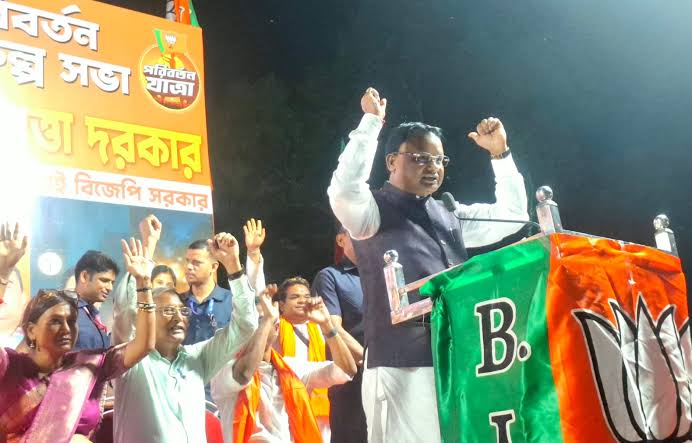
Odisha Chief Minister Mohan Charan Majhi addressed the Parivartan Sankalp Rally in Moyna, West Bengal, where he called for political change ahead of the state’s upcoming elections and criticised the performance of the West Bengal government.
Addressing the gathering, Majhi said the turnout and enthusiasm at the rally indicated growing public demand for an alternative political direction.
He accused the state government of failing to fulfil its promises and alleged that corruption and injustice had weakened public confidence in the administration.
Majhi said West Bengal had once occupied a leading position in Indian industry, culture and intellectual life but had subsequently fallen behind in development.
Without directly naming Chief Minister Mamata Banerjee, he criticised what he described as “syndicate politics” and “pisi culture” in the state’s administration.
Majhi alleged that the absence of a clear development strategy had restricted employment and economic opportunities for young people and women in West Bengal.
Raises Issue of President Droupadi Murmu’s Visit
The Odisha Chief Minister also referred to the treatment of President Droupadi Murmu during her recent visit to West Bengal.
Majhi alleged that obstructions or inappropriate conduct during the President’s official programme amounted to disrespect towards the country’s highest constitutional office.
He said such conduct would also be viewed as an affront to women and tribal communities across India.
Development Emerges as Central Rally Theme
Majhi used the rally to contrast West Bengal’s historical importance with what he described as its present development challenges.
His address focused on employment, women’s opportunities, public administration, corruption and respect for constitutional institutions.
Calling for a change in government, Majhi urged voters to assess the state’s development record and consider a different political direction in the forthcoming elections.
The remarks formed part of the intensifying political campaign in West Bengal, where governance, employment, corruption and development are expected to remain prominent electoral issues.