

Visionary development push brings 330 projects, model schools, a technology park, medical institutions, free cancer screening, student mobility and stronger infrastructure
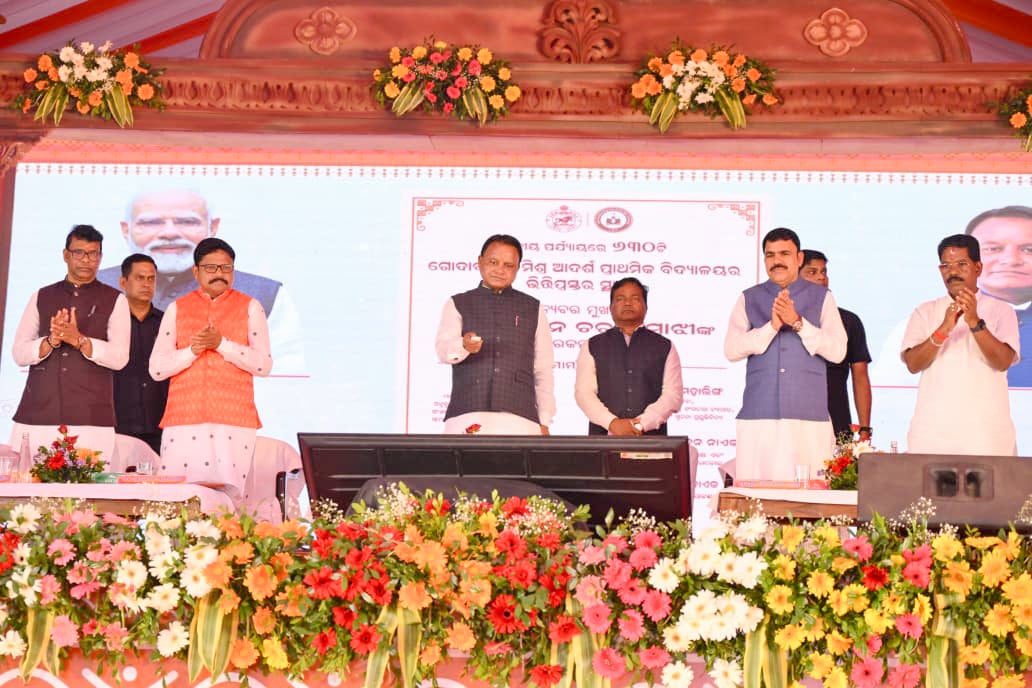
Chief Minister Shri Mohan Charan Majhi has opened a powerful new chapter in Keonjhar’s development journey by inaugurating and laying the foundation stones for 330 projects worth more than ₹1,292 crore.
The comprehensive development package reflects the Chief Minister’s vision of building a modern, educated, healthy and employment-ready Odisha. It brings together investments in primary and higher education, technology, healthcare, medical training, public transport, emergency services, sanitation and road connectivity.
Of the 330 projects, the Chief Minister inaugurated 198 completed projects worth approximately Rs.412 crore and laid the foundation stones for 132 new projects involving an investment of more than Rs.880 crore.
The scale and diversity of the projects demonstrate an integrated development model in which education creates opportunity, healthcare protects families, technology generates employment and infrastructure connects people to progress.
Details of the development package were released by the Chief Minister’s Office.
CM Majhi Places Education at the Heart of Odisha’s Future
The centrepiece of the programme was the launch of the third phase of the Godabarish Mishra Adarsha Prathamika Vidyalaya scheme.
Foundation stones were laid for 630 model primary schools across Odisha, including 35 in Keonjhar district. These schools are expected to be developed at a combined cost of nearly Rs.4,000 crore.
The State Government has set a broader target of developing 2,200 model primary schools between 2025-26 and 2028-29, with a proposed investment of approximately Rs.12,000 crore.
Each model school is planned as a modern learning campus with improved classrooms, digital education facilities, sports infrastructure and a child-friendly academic environment. The larger objective is to develop at least one high-quality primary school in every gram panchayat.
For Chief Minister Majhi, the scheme carries deep personal importance. His development philosophy recognises that the strength of Odisha’s future will be determined by the quality of education provided to children at the foundational stage.
By investing in primary education, the government aims to reduce the gap between urban and rural schools and provide children in tribal and remote communities access to modern learning opportunities.
The initiative also signals an important shift in public education. A government primary school should not be treated merely as a building where lessons are delivered. It should become a complete centre for learning, sports, creativity, confidence and personal development.
A Dream Project Inspired by Grassroots Experience
Chief Minister Majhi has described the model primary school programme as a project close to his heart.
His understanding of the challenges faced by rural children emerged from years of grassroots public service and his experience representing Keonjhar. That background has shaped an education policy focused on practical needs rather than distant planning.
The government has introduced Shishu Vatika in more than 45,000 schools, extended midday meals and free textbooks to students of Classes IX and X, and appointed 28,639 teachers over the past two and a half years, according to the Chief Minister.
These initiatives form part of a larger attempt to strengthen the complete learning journey, beginning with early childhood education and continuing through secondary, higher and professional education.
School and Mass Education Minister Nityananda Gond said education remains the strongest instrument of social transformation. He reiterated the government’s commitment to providing children with high-quality learning opportunities from the primary level.
Dharanidhar University Gets a New South Campus
The Chief Minister also inaugurated the South Campus of Dharanidhar University, developed at a cost of Rs.14 crore.
The new campus represents an important expansion of higher education infrastructure in Keonjhar. It is expected to provide students with an improved academic environment and support the university’s future growth.
The development of the campus reinforces the government’s commitment to ensuring that young people in northern Odisha can pursue higher education closer to home.
A stronger university system can also support research, innovation, entrepreneurship and partnerships with emerging industries. With Keonjhar preparing for new investments in technology and business services, Dharanidhar University could play an increasingly important role in developing the required talent.
Tech-Business Park to Create Opportunities at Home
One of the most ambitious projects launched during the programme was the proposed 15-storey Tech-Business Park in Keonjhar.
The modern facility will be developed over 5.51 acres at an estimated cost of Rs.237 crore. It is designed to attract technology companies, business-service enterprises, startups and other knowledge-based activities to northern Odisha.
The project directly supports Chief Minister Majhi’s determination to take modern employment opportunities beyond Bhubaneswar and other established urban centres.
For generations, many young people from Keonjhar and neighbouring districts have travelled to Bengaluru, Hyderabad and other major cities in search of professional employment. The Chief Minister’s vision is to create comparable opportunities within Odisha so that talented young people can build successful careers without leaving their families and communities.
The Tech-Business Park is therefore not just another building project. It represents a new economic direction for Keonjhar.
By combining digital infrastructure, office space and access to a growing pool of educated young people, the facility could help establish Keonjhar as an emerging technology and business destination.
It may also encourage startups, support local entrepreneurs and create indirect demand for housing, transportation, food services, maintenance and other urban businesses.
Odisha’s First Indigenous Preventive Cancer Screening Centre
In a major healthcare achievement, Chief Minister Majhi inaugurated Odisha’s first fully indigenous technology-based Preventive Cancer Screening Centre at the Dharanidhar Medical College campus.
The centre has been developed with District Mineral Foundation support at a cost of approximately ₹6 crore. Screening services are expected to be provided free of cost.
Early detection is one of the most important factors in successful cancer treatment. However, people in rural and remote areas may delay screening because of distance, cost or limited awareness.
The new centre can help identify potential cases at an earlier stage and guide patients towards appropriate diagnosis and treatment. It can also support public-awareness programmes and preventive healthcare initiatives across the district.
The project reflects a wider change in Odisha’s healthcare strategy. The focus is expanding from treating advanced illness to preventing disease and detecting serious health conditions early.
The Chief Minister’s Office described the projects as a new direction for healthcare and medical education in Keonjhar.
Dental, Nursing and Pharmacy Education Expanded
Chief Minister Majhi laid the foundation stones for a seven-storey dental college to be constructed at a cost of ₹58.40 crore and a 10-storey nursing college estimated at ₹63 crore.
He also announced that a government pharmacy college would be established in Keonjhar.
Together, these institutions will strengthen medical education and help develop a larger pool of trained healthcare professionals.
The dental college can expand access to specialised oral healthcare while producing qualified dental professionals. The nursing college can help meet the growing need for trained nurses across hospitals and health centres.
The proposed pharmacy college will add another important component to Keonjhar’s emerging medical education ecosystem.
With a medical college, dental college, nursing college, pharmacy college and preventive cancer screening centre, Keonjhar is being positioned as a significant healthcare and medical education hub for northern Odisha.
Modern Facilities Strengthen Dharanidhar Medical College
The Chief Minister also inaugurated and launched several supporting facilities at Dharanidhar Medical College and Hospital.
These included:
- A maternal and child healthcare department building developed at approximately ₹10 crore
- A modular operation theatre complex costing around ₹32 crore
- A multi-utility centre
- A police outpost
- A 30-bed police barrack
These facilities will strengthen clinical care, improve the hospital environment and support safer and more efficient operations.
Investment in maternal and child healthcare is particularly important for reducing preventable health complications and ensuring timely care for mothers and newborns.
The modular operation theatre complex can help improve surgical capacity and infection-control standards while enabling the hospital to handle a wider range of procedures.
23 Ambulances Strengthen Emergency Healthcare
As part of the development programme, 23 new ambulances funded through the District Mineral Foundation were deployed across Keonjhar.
The vehicles will strengthen emergency medical transportation and help patients reach healthcare facilities more quickly.
For residents of remote and difficult-to-reach areas, the availability of an ambulance can determine whether critical medical attention is received in time.
The addition of 23 vehicles reflects the Chief Minister’s focus on last-mile healthcare, ensuring that investments in hospitals are supported by an effective system for bringing patients to those facilities.
Free Mobility Cards Bring Relief to Students
Chief Minister Majhi also launched free National Common Mobility Cards for students and distributed cards to students of Dharanidhar University.
The cards will facilitate free bus travel, making it easier and more affordable for students to reach their institutions.
Transportation costs can place a significant burden on students from low-income and rural families. By reducing that expense, the mobility initiative can support regular attendance and improve access to education.
The programme connects two important parts of the Chief Minister’s development vision: modern public transport and equal educational opportunity.
A student should not lose access to a college or university simply because daily travel is unaffordable. The mobility card is a practical intervention aimed at removing that barrier.
Cleaner Cities Through Modern Sanitation Equipment
The government also provided 26 sanitation vehicles and equipment to Keonjhar, Joda and Barbil municipalities.
The equipment includes light commercial vehicles, tractors, sprinklers and cesspool vehicles designed to improve waste management, urban sanitation and civic services.
Rapid urban growth requires municipalities to expand their capacity for waste collection, street cleaning, drainage maintenance and public hygiene.
By strengthening municipal fleets, the government is supporting cleaner and healthier urban environments across the district.
Roads to Carry Keonjhar’s Development Forward
Chief Minister Majhi also highlighted major steps being taken to improve road connectivity.
Work has been initiated to widen important roads connecting Keonjhar, while a ring road has been planned for Barbil. These projects are expected to improve the movement of people and goods, reduce congestion and support industrial development.
Stronger roads will connect educational institutions, hospitals, markets, industrial centres and residential areas. They will also help farmers, businesses and transport operators reach larger markets more efficiently.
For a mineral-rich district with growing industrial activity, better road infrastructure is essential. The government’s approach recognises that investments in education, healthcare and technology must be supported by dependable physical connectivity.
A Leader Rooted in Keonjhar
During the programme, Chief Minister Majhi reflected on his deep association with Keonjhar.
Although he now carries the responsibility of leading the entire state, he told the people of the district that he remained their familiar “Mohan Bhai” and would continue serving the land where his public journey began.
The message captured an important quality of his leadership: statewide ambition combined with a strong grassroots connection.
His familiarity with Keonjhar’s challenges has helped shape a development package that responds to needs across different stages of life, from primary school and university education to employment, healthcare and public mobility.
An Integrated Model of Development
The ₹1,292 crore programme is significant not only because of its financial scale but also because of the way its components work together.
The model schools will strengthen foundational education. Dharanidhar University and the new professional colleges will expand higher education. The Tech-Business Park will seek to create employment for graduates. The cancer screening centre, ambulances and medical infrastructure will protect public health. Mobility cards will help students reach institutions, while improved roads and sanitation will strengthen the wider living environment.
This is the central strength of Chief Minister Majhi’s vision.
Development is not being treated as a collection of isolated construction projects. It is being planned as a connected system in which education, employment, healthcare, mobility and urban services reinforce one another.
Keonjhar Enters a New Era
The launch of 330 projects represents one of the most comprehensive development interventions undertaken in Keonjhar.
It places the district on a path towards becoming a centre for modern education, professional healthcare, technology-based employment and improved public services.
The initiatives also carry a wider message for Odisha. Districts rich in natural resources must receive modern institutions, economic opportunities and high-quality public infrastructure.
Under Chief Minister Mohan Charan Majhi’s leadership, Keonjhar is being developed not merely as a mineral-producing district but as a centre of knowledge, healthcare, technology and human progress.
From model primary schools to a 15-storey Tech-Business Park, from free cancer screening to new medical colleges, the Chief Minister’s development push reaches every major area affecting the lives of ordinary citizens.
The ₹1,292 crore package is therefore more than a collection of projects. It is the expression of a clear and ambitious vision: children should receive quality education, young people should find opportunities near home, families should have access to modern healthcare and every region should participate in Odisha’s progress.
With decisive leadership, targeted investments and a strong connection to the grassroots, Chief Minister Mohan Charan Majhi is positioning Keonjhar as a powerful example of inclusive and future-ready development.
 Prasanta Patnaik